


 下载APP
下载APP 报料
报料 关于
关于
中国日报双语新闻·网站 2026-07-13 11:02:50
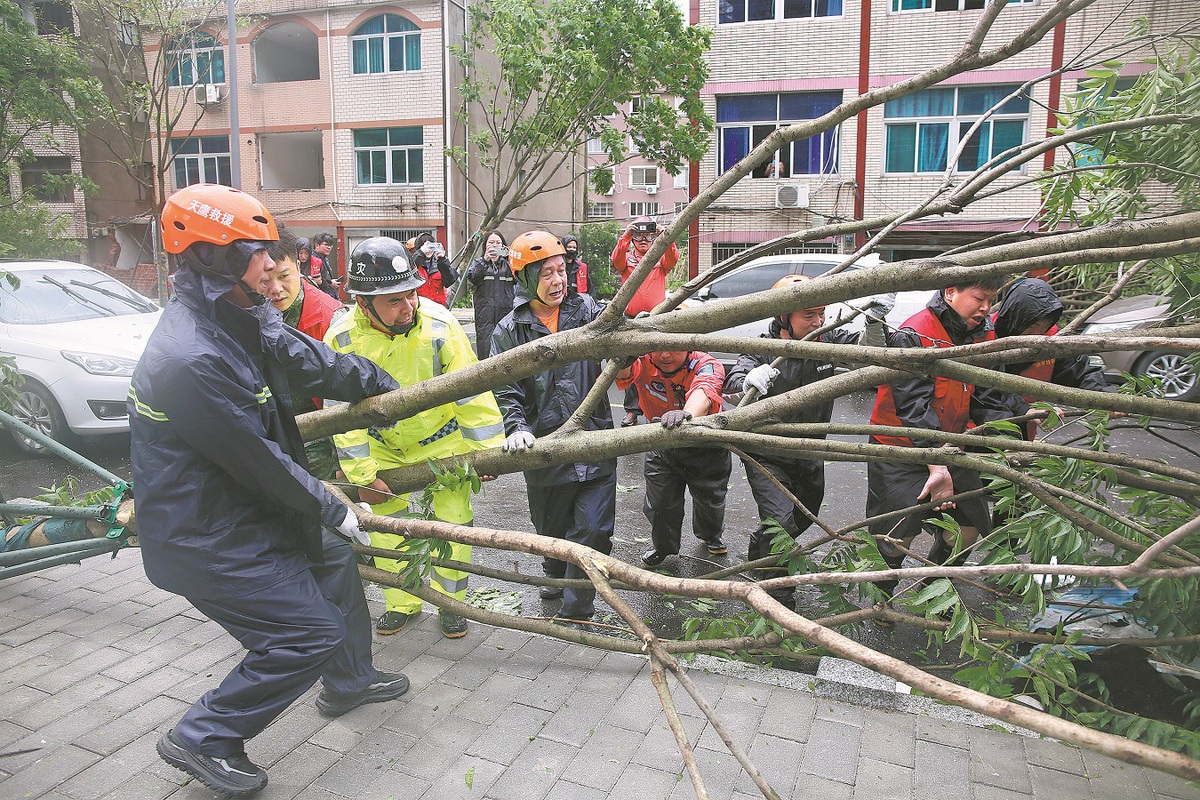
Volunteers and rescue workers clear trees felled by Typhoon Bavi in Wenling, Zhejiang province, on Sunday. The city entered the typhoon's force-10 wind zone on Saturday, when coastal waves exceeded 10 meters, prompting the evacuation of all fishermen. By Sunday afternoon, Bavi had weakened to a tropical storm.
Chinese authorities have intensified flood control and disaster relief efforts as Typhoon Bavi continued to affect large parts of the country on Sunday. As the typhoon moved inland after making landfall twice on the eastern coast, many areas experienced record-breaking rainfall, destructive winds and disruption in transportation, prompting the precautionary relocation of millions of people.
Although the storm is weakening, meteorologists warned that its circulation and abundant moisture supply will continue to trigger extreme rainfall and strong winds over a vast area.
Bavi first made landfall at around 11:20 pm on Saturday in Yuhuan, Zhejiang province, accompanied by sustained winds of 144 kilometers per hour. It made a second landfall shortly after midnight on Sunday near Qingjiang town in Wenzhou, Zhejiang, packing winds of 137 km/h. By Sunday morning, the typhoon had weakened into a severe tropical storm, according to the National Meteorological Center.
At 9 pm on Sunday, Bavi's center was located in Chuzhou, Anhui province, with maximum sustained winds of 83 km/h.
The meteorological center said the storm was likely to move in a northwesterly direction, while gradually weakening. It is expected to turn northeast over eastern Anhui on Monday before crossing the Shandong Peninsula into the northern Yellow Sea on Tuesday, where it is likely to transition into an extratropical cyclone.
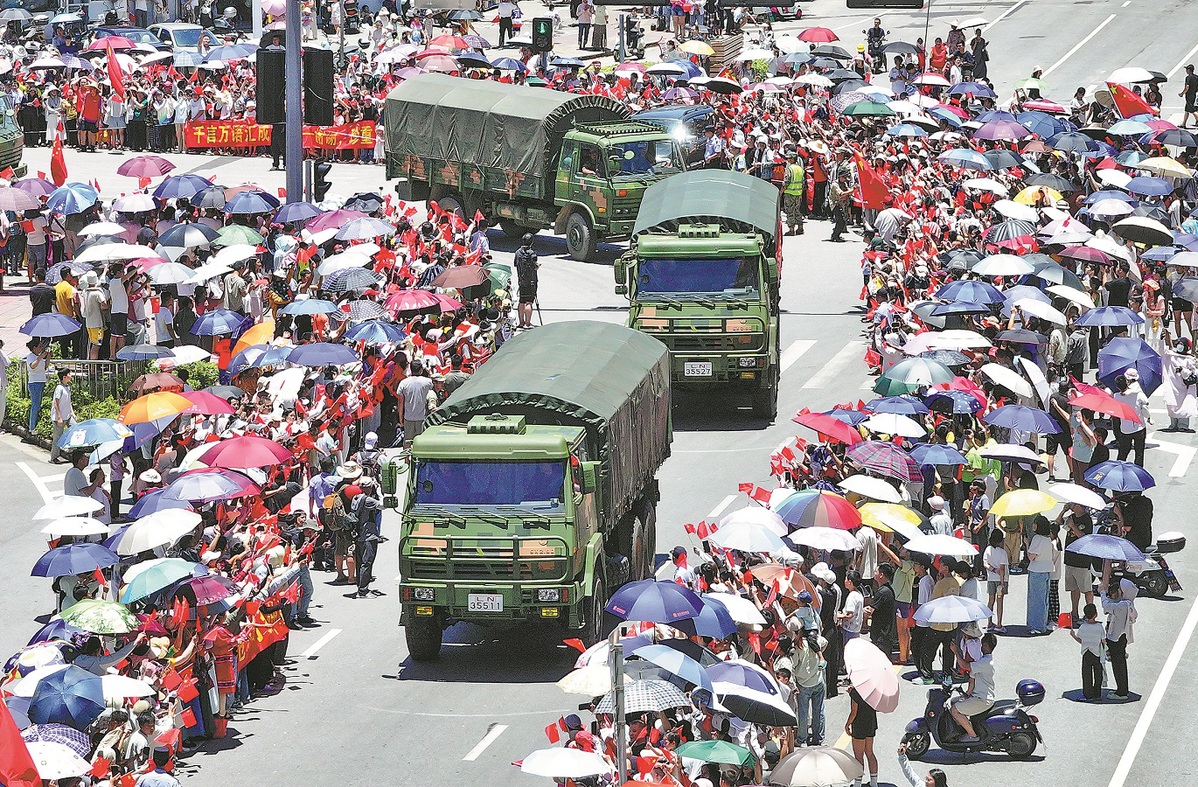
Despite weakening, Bavi's remaining energy, combined with moisture from the southwest monsoon, means the threat is far from over.
Forecasters predict that parts of East China, North China and Northeast China will be lashed by heavy to torrential rain through Tuesday.
The Ministry of Water Resources on Sunday upgraded its flood alert to yellow, the third-highest level in China's four-tier weather warning system, noting that heavy rainfall could trigger flooding in some rivers, mountain torrents and urban waterlogging.
The National Meteorological Center maintained its orange alert for rainstorms on Sunday afternoon, the second-highest level in China's four-tier weather warning system.
Sun Qianqian, a meteorologist with Weather China, a website affiliated with the China Meteorological Administration, described Bavi as a large and powerful storm, the impact of which will be prolonged, widespread and locally extreme.
"Landfall does not mean the threat has passed," she said, adding that heavy rainfall and persistent strong winds will continue to affect a broad swath of the country as both the storm's inner circulation and long-range moisture transport move across multiple regions.
The center warned that the risk of flash floods and landslides remains extremely high in parts of northeastern Hebei province and southern Anhui through Tuesday, urging the public to avoid mountainous areas and river valleys.
The Ministry of Water Resources and the China Meteorological Administration jointly issued a red alert for mountain torrents on Sunday afternoon, the highest of the four-tier warning system.
From Sunday night to Monday night, thunderstorms with strong winds, or hail, are expected in southern Northeast China, eastern North China and in central-eastern areas south of the Yangtze River. In southeastern Anhui, thunderstorms may bring gusts that may reach or exceed 117 km/h, the NMC said.
The deluge has already broken records in several locations. Across China, 246 national weather stations recorded extreme torrential rainfall.
In one station in Yueqing city, Zhejiang, up to 435 millimeters of rain fell within 24 hours, setting a local record and surpassing the previous high of 286.5 mm set in 2024.
Zhejiang's emergency management department said more than 1.7 million people across the province had been evacuated as of Saturday morning. By Sunday morning, authorities had issued 225 weather warnings across Zhejiang, including 42 for heavy rainfall, local media reported. In Hangzhou's West Lake scenic area, workers cleared 16 fallen trees and 232 broken or withered branches.
In Fujian province, more than 180,000 people had been evacuated from hazardous areas by Saturday afternoon, Fujian Daily reported.
"After receiving the typhoon warning, we activated the Yuetan Reservoir's emergency response plan and maintained round-the-clock monitoring while preemptively lowering water levels to create additional flood-control capacity," said Zhang Jun, director of the management office of Yuetan Reservoir in Huangshan, Anhui.
Several tourist attractions in Huangshan, including the Huangshan Mountain scenic area, were closed from Saturday through Sunday. Special reinforcement measures were also taken to protect ancient trees, including the 1,000-year-old Guest-welcoming Pine.
The storm also disrupted transportation services. Several airports in Fujian, Zhejiang and Shanghai experienced flight disruptions on Saturday.
At noon on Sunday, Hefeinan Railway Station, Anhui's largest high-speed rail hub, announced that all high-speed train services for the day had been suspended except for one from Hefei to Xi'an, Shaanxi province.
By Saturday, Zhejiang had opened more than 19,000 emergency shelters capable of accommodating over 1.9 million people, with 72 hours' worth of essential supplies in place, Zhejiang Daily reported.
On Sunday, the central government dispatched 70,000 relief items, including folding beds, quilts and emergency kits, to Zhejiang, Tianjin and Anhui.
Meanwhile, the National Development and Reform Commission allocated 100 million yuan ($14.75 million) to support post-typhoon emergency recovery efforts in Zhejiang. The funds will mainly be used to restore damaged infrastructure, including roads and water conservancy facilities, as well as public service facilities such as schools and hospitals.
责编:冯宇轩
一审:冯宇轩
二审:秦慧英
三审:张权
来源:中国日报双语新闻·网站
我要问
 湘公网安备 43010502000374号