


 下载APP
下载APP 报料
报料 关于
关于
湖南日报·新湖南客户端 2026-05-21 10:53:44
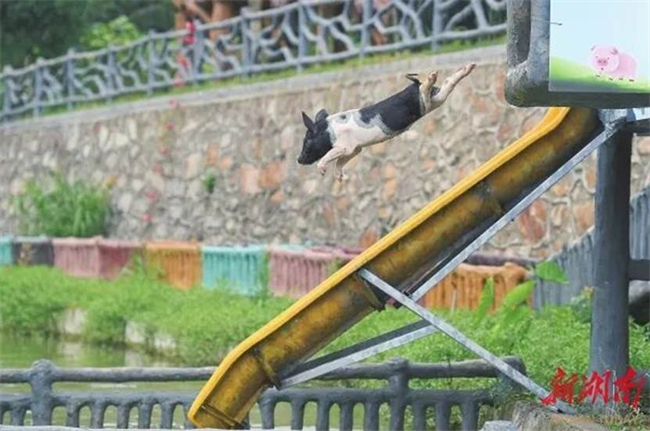
At an ecological farm in Ningxiang City, an adorable and charming little spotted pig jumps into the water from a platform over one meter high. (File Photo/Gu Pengbo, Hunan Daily)
Seed Profile
Hunan, a major pig-raising province, boasts rich local pig breed resources. Ningxiang spotted pigs, Shaziling pigs, Daweizi pigs, Xiangxi black pigs, and Qianshao spotted pigs are all included in the China National Protection List of Livestock and Poultry Genetic Resources. Among them, the Ningxiang spotted pig has been promoted globally by the Food and Agriculture Organization of the United Nations (FAO), and the Shaziling pig has been selected as a typical case in the "National Top Ten Examples of Livestock and Poultry Genetic Resource Transformation," making both rare genetic resources in pig production.
While the domestic live pig market is hitting bottom, the price of Hunan's local native pigs remains stable. Ningxiang spotted pigs and Shaziling pigs are priced at over 18 yuan per kilogram, bringing considerable profits to pig farmers.
"For each pig marketed, an ordinary crossbred pig results in a loss of 500 yuan, while a Shaziling pig generates a profit of about 500 yuan," said Wu Maisheng, a senior researcher for Xiangtan Shaziling pigs. He added that this spring, pig farmers have been switching to raising native pigs, leading to a shortage of Shaziling piglets.
The live pig market features accelerated differentiation, with Ningxiang spotted pigs highlighting an "advantage on taste bud." At Freshippo in Changsha and Walmart's Sam's Club, consumers taste the meat on-site. With its tender texture, smooth mouthfeel, and fragrant aftertaste, Liushahe spotted pork sells for 100 yuan per kilogram yet remains in short supply.
"As consumption upgrades, nothing beats delicious food," said Li Shuchu, chairman of the Hunan Liushahe Spotted Pig Ecological Farming Co., Ltd. Standing on the crest of the wave, native pigs have paved a "golden track," delivering a feast for consumers' taste buds.

On April 2, a technician conducts African swine fever pathogen testing at the Chuwangxiang Service Center in Changtian Village, Ningxiang City. (Photo/Tong Zhenxi, Hunan Daily)
World-class "Pig Vessel" Originates from Central Hunan
The Hunan Museum houses a precious cultural relic—Shi Zun (pig-shaped wine vessel), which was unearthed from Chuanxing Hill in Guihua Village, Jiuhua Township, Xiangtan County in 1981. It is the only pig-shaped artifact among existing bronze wares from the Shang Dynasty (1600 BC–1046 BC).
A replica of the "Shi Zun" is exhibited at the Shaziling Pig Science and Innovation Museum in Xiangtan City. It is 40 centimeters tall and 72 centimeters long, with erect wind-catching ears, bristling mane on its neck and ridge, two wide and round eyes, and a long, protruding snout, exuding a wild essence.
"This is our museum's treasure," a guide explained. The appearance of the "Shi Zun" as a ritual wine vessel indicates that pig farming was widespread in Xiangtan area over 3,000 years ago.
Based on the Shi Zun's physical features, structural characteristics, and head-to-body ratio, historians posited that it likely represents a domesticated boar.
"'Shi Zun' was unearthed in Xiangtan, and its appearance resembles the local Shaziling pig," Wu Maisheng noted. Over more than 3,000 years of domestication and selective breeding, the Shaziling pig has developed distinctive features: "black head and rump, spot-free coat, butterfly-shaped ears, and a short tail," making it a typical representative of the "Two-End-Black" group in Central China.
Shaziling pigs are easy to raise, characterized by their tolerance for coarse feed and high adaptability. They consume pig feed made from sweet potato vines, rice bran, straw, and distiller's grains, converting them all into muscle and fat.
In the 1950s, Hubei, Jiangxi, Henan, Hebei, Guangdong, and Guangxi introduced Shaziling pigs. At one point, Shaziling pigs held half of the market share in Hunan's live pig market.
Meanwhile, Ningxiang, Changsha – only a few dozen kilometers away from Xiangtan – is home to spotted pigs that enjoy worldwide renown.
In recent years, within a 100-kilometer radius around Liusha River in Ningxiang, archaeologists discovered numerous traces related to "pigs": pottery pigsties, pottery pigs, and pig feeding troughs. Legend has it that the spotted pig was already famous far and wide before the Song Dynasty (960–1279).
According to records, by the Hongwu reign of the Ming Dynasty (1368–1398), Ningxiang spotted pigs were praised as being "even more plump and delicious than those from other regions." They were widely raised by the early Qing Dynasty (1644–1700). By the Jiaqing reign (1796–1820), a prosperous scene unfolded where "household was incomplete without pigs, and every family raised them."
Over a long period of domestication, the Ningxiang spotted pig has developed an appearance featuring a black back and upper body, a white belly, and a distinctive white band encircling its neck. Meanwhile, it has traits like tolerance for coarse feed, early maturity, easy fattening, strong fat storage capacity, and tender meat quality.
In 1971, a FAO delegation visited Ningxiang to inspect pig production. Their magazine Animal Breeding featured an image of the Ningxiang spotted pig on its cover, introducing it to the whole world.
Beyond the Shaziling and Ningxiang spotted pigs, the Daweizi pig from Changsha County is also listed among the "National Famous Pigs."
"Having three nationally renowned local pig breeds clustered within a 100-kilometer radius is unique in the entire country," stated Yin Yulong, an academician of the Chinese Academy of Engineering. "This clearly shows that people in Hunan know how to raise pigs."
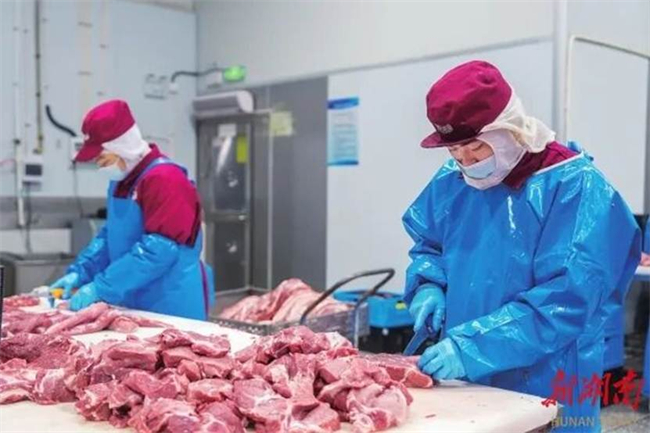
On April 2, in the production workshop of the Hunan Liushahe Spotted Pig Ecological Farming Co., Ltd., workers pack pork destined for large supermarkets like Freshippo and Sam's Club. (Photo/Tong Zhenxi, Hunan Daily)
"Famous Pig Breed Conservation" Moves Towards Prosperity
It is widely known that native pork tastes delicious with tender and fresh texture. This is because native pig breeds have undergone thousands of years of domestication and evolution, resulting in unique genetics.
"Pure genetics are the foundation of great flavor," said Peng Yinglin, a provincial pig breeding expert. The Shaziling pig and Ningxiang spotted pig were once endangered. Only through arduous conservation efforts were their superior flavor genes preserved.
The excellent meat quality of native pigs is an advantage, but their slow growth and high fat content are disadvantages. In times of scarcity, any meat was good enough; no one cared if it was fat or lean.
As living standards improved, leaner meat became more popular. A folk saying goes that "People eat coarse grains in times of bumper grain harvests, and choose lean meat when livestock thrive."
To increase the lean meat ratio in pigs, in the 1980s, a nationwide "Exotic boars for genetic improvement, local sows for native breed conservation, and first-generation crossbred pigs for fattening" initiative was proposed to push for the "crossbreeding improvement" of local pig breeds.
This initiative led to genetic mixing in native pig lines, causing a sharp decline in pure-blood populations. By 2000, pure-blood Liushahe native spotted pigs had become extremely rare, and pure-blood Shaziling breeder pigs numbered just over 1,000, putting both breeds on the brink of extinction.
Li Shuchu, who had raised and traded spotted pigs alongside his grandfather since childhood, learned from television that the Ningxiang spotted pig was endangered. He resolutely left behind his business elsewhere and returned to his hometown to become a pig farmer.
With the support of the local animal husbandry authority, Li Shuchu tapped into remote villages, meticulously searching for the pure-blood breeder pigs on the verge of extinction. Ultimately, he bought back seven pure-blood boars and 50 sows at high price. In 2003, Li Shuchu established Hunan's first indigenous quality pig breed conservation farm—the Liushahe Spotted Pig Conservation Farm.
According to modern breed conservation theory, to maintain genetic diversity of a local pig breed requires preserving at least 10 independent bloodlines, to prevent the loss of superior genes. Li Shuchu frequently visited scientific research institutions and conducted conservation breeding under expert guidance on an ongoing basis. The Ningxiang spotted pig expanded from seven family bloodlines to 10 family bloodlines, effectively restoring vitality of the species. Hence, Li Shuchu became known as a "Spotted Pig Commander."
Just as the conservation of Ningxiang spotted pigs was inseparable from Li Shuchu, the iconic figure in the conservation of Xiangtan's Shaziling pig is Wu Maisheng.
In 1984, the Xiangtan Municipal Government issued a document to task the livestock breeding stations under the municipal animal husbandry department with the mission of protecting the Shaziling pig breed. Wu Maisheng graduated from university in the very year and was assigned to work in a breeding station, where he dedicated himself to Shaziling pig conservation for over four decades. He was thereby nicknamed "Father of the Shaziling Pig."
"Conserving the Shaziling pig breed was rather challenged at the start," Wu Maisheng recalled. At that time, a special fund of 20,000 yuan and a quota of 100 tonnes of feed grain were allocated annually, which could only sustain 12 boars and 50 sows.
There was a joke about "lazy boars" at the Xiangtan Livestock Breeding Station. Some government officials inspected the station and commented that, in the countryside, two boars were more than enough for 50 sows, questioning why the station need to keep 12 boars. They accused the extra boars of being lazy and wasting feed.
The technicians explained repeatedly that the 12 boars represented 10 different bloodlines, not being lazy, and invited an expert to testify. The inspectors were finally convinced.
Wu Maisheng understood that to boost the Shaziling pig population to thrive, the key lies in making pig farming profitable. So that the breed can be accepted in the market.
"To make Shaziling pigs grow faster and produce more lean meat and to ensure farmers earn money," centering on this goal, Wu Maisheng led his research team have been conducting comprehensive studies on Shaziling pig's growth, reproductive performance, meat quality traits, crossbreeding combinations, and genetic inheritance. They eventually cultivated the Shaziling pig synthetic line—the Xiangsha pig.
"Previously, raising Shaziling pigs was unprofitable, so farmers didn't keep them," Chu Sui'an, manager of the Xiangtan Helong Ecological Agriculture Company, recounted that five years ago, he was persuaded by Wu Maisheng to purchase over 50 breeding pigs and started raising Xiangsha pigs.
Chu Sui'an has reaped benefits in the following few years. The Xiangsha pig synthetic line maintains the advantages of high fecundity and good meat quality while growing fast. Compared to purebred Shaziling pigs, the feeding period for Xiangsha pigs is about 100 days shorter, while the lean meat percentage increasing by 17 percentage points, making them highly sought after in the market.
Currently, the number of specialized Shaziling pig farmers in Xiangtan has grown to over 1,000 households, raising more than 200,000 Shaziling pigs (including Xiangsha pigs) annually, spurring province-wide Shaziling pig production scale to exceed 400,000.
For the genetic conservation of the Shaziling pig, Wu Maisheng has deeply collaborated with Academician of the Chinese Academy of Engineering Yin Yulong and his team, utilizing modern biotechnology to breed cloned Shaziling pigs.
On January 24 last year, Hunan's first somatic cell cloned Shaziling pig was born in Xiangtan County. On March 30 this year, this cloned Shaziling pig gave birth to 11 Shaziling piglets, securing conservation of the breed.
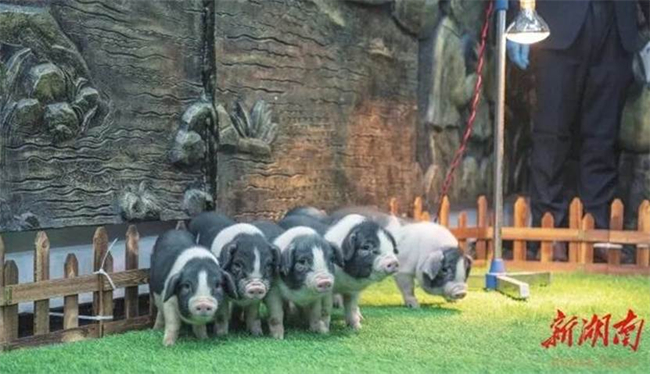
Spotted piglets bask under heat lamps at Hunan Liushahe Spotted Pig Ecological Farming Co., Ltd. (File photo/Tong Zhenxi, Hunan Daily)
Industry "Linkage" Drives a Virtuous Cycle
On a weekend, a Freshippo store in Changsha bustled with people. In the meat section, a "sampling" promotion for Ningxiang spotted pork drew wide attention. Sales staff placed small slices of pork belly into a hot pan. As the fat sizzled and aroma filled the air, customers eagerly came to taste.
"Indeed, the best ingredients need only the simplest cooking," exclaimed a customer after tasting. Since March this year, Ningxiang spotted pork has launched tasting promotions at Freshippo and Sam's Club in Changsha, driving strong demand for chilled fresh meat.
"The proof of the pudding is in the eating." Li Shuchu explained that the company collaborates with retailers to launch tasting activities, cooking the spotted pork simply by frying or stewing in plain water without any seasoning, to highlight the meat's pure, savory flavor.
As the Ningxiang spotted pig population rapidly expands, how does it "stood out to fame"? Li Shuchu has tried many methods but ultimately decided to focus on experiential marketing, relying on trial sales and tasting activities to deliver deliciousness directly to consumers' taste buds.
The Ningxiang Municipal Government has given strong support to the leading enterprises like Liushahe Animal Husbandry and Chuwangxiang, striving to build a "spotted pig+" industrial chain.
At the Spotted Pig Town in Hongfu Village, Liushahe Town, various endearing and lifelike spotted pig sculptures and wall paintings are seen everywhere. Spotted pig-themed farmhouses and a pig culture exhibition hall attract tourists for photo shooting and visits.
Through business matchmaking, Ningxiang spotted pork "fell in love" with the famous Hunan chain restaurant "Fei Da Chu" (Chef Fei). Using Ningxiang spotted pork as the core ingredient, a single dish—stir-fried pork with chili—swept the nation, winning the crown of "King of Stir-fried Meat."
The reputation of Ningxiang spotted pigs grows louder by the day, with annual marketings reaching 550,000 head. The entire industrial chain's output value has exceeded 5.3 billion yuan, providing over 10,000 job vacancies.
Stir-fried pork with chili, steamed pork belly with preserved mustard greens, Mao's braised pork in brown sauce...In Ningxiang, spotted pork is the sole choice for banquet dishes. In Xiangtan, the "hometown of great Chairman Mao," Shaziling pork takes the top spot for stir-frying pork with chili, braised pork in brown sauce, and steamed pork belly.
Five years ago, Hunan cuisine master Bin Ce gave up his established business in Myanmar, returning home and investing in the development of Shaziling pigs. Leveraging his expertise as a master chef, he created a Shaziling "Whole Pig Feast," char siu stuffed with salted egg yolk, and other serial products. All these have become signature dishes at local hotels and restaurants.
To promote Shaziling pigs, the Ningxiang's agriculture and rural affairs department has organized a series of events, such as the Shaziling Pig Cooking Competition, and Shaziling pig mascots—"Shasha" and "Lingling," making the Shaziling pig a household name. The Xiangtan municipal government also attracted investment to build a smart cold chain logistics park. Its first phase has been put into operation, addressing bottlenecks in the Shaziling pig industry's development.
In the logistics park, Shaziling pigs are processed into over 40 different products, and delivered to nationwide markets via cold chain logistics. In a corner of the park, live streaming has been adopted for meat sales, enabling customers to browse and buy meat online with the same ease as shopping in a physical supermarket.
According to plans, by 2030, the annual slaughter volume of Shaziling pigs will exceed 1 million head, generating an annual output value of 10 billion yuan across the entire industrial chain.
Wu Maisheng said that the Shaziling pig has moved from conservation to expansion, forming a virtuous cycle of "large-scale farming—slaughter and processing—e-commerce marketing—cold chain delivery." A 10-billion-yuan industrial chain is emerging at an accelerated pace.
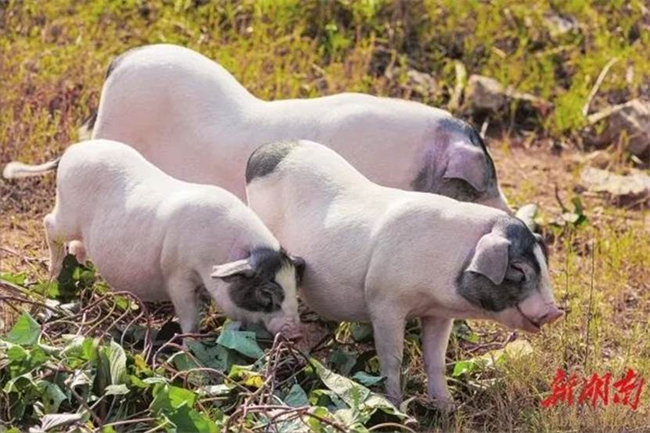
Xiangtan Shaziling pigs feed outdoors. (File photo provided by the Xiangtan Livestock Breeding Station)
Expert Commentary
Conserving through development, while developing through conservation
--Yin Yulong, academician of the Chinese Academy of Engineering
The Ningxiang spotted pig and Shaziling pig have moved from endangerment to prosperity, forging a scientific development path of "conserving through development, while developing through conservation."
The Shaziling pig has successfully given rise to the Xiangsha pig synthetic line, and significant progress has been made in breeding a synthetic line for the Ningxiang spotted pig. This "promoting conservation through use" model makes pig farming profitable, fundamentally resolving many challenges inherent in traditional conservation approaches. The success of the first cloned Shaziling pig signified that somatic cell cloning technology has progressed from "birth and survival" towards a stage of being "reproducible, heritable, and industrializable," adding a security for conservation efforts.
Cloning technology has addressed two major pain points of traditional conservation. First, it mitigated emergency risks, effectively providing "biological insurance" for genetic resources. Second, it replicated superior individuals, establishing a "living animals + cells" dual protection system.
However, cloning cannot ultimately replace live animal conservation, because of limited cloning efficiency and relatively high costs. Moreover, it cannot increase the genetic diversity. Therefore, protecting superior indigenous livestock and poultry breeds requires continued efforts, continuously strengthening the industrial chain based on "promoting conservation through use" to achieve a virtuous cycle between conservation and development.
责编:黄思婷
一审:黄思婷
二审:秦慧英
三审:张权
来源:湖南日报·新湖南客户端
我要问
 湘公网安备 43010502000374号