


 下载APP
下载APP 报料
报料 关于
关于
中国日报网 2026-05-17 15:51:24
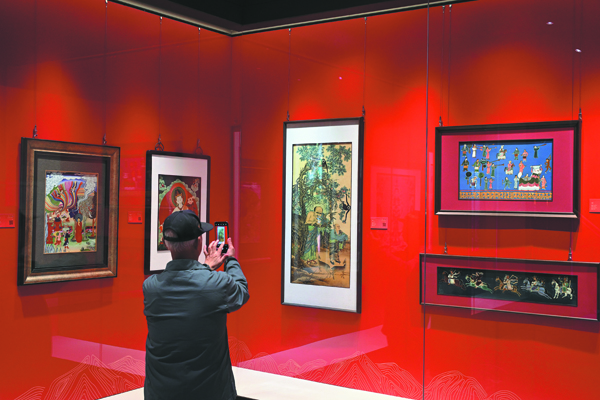
Inside Beihai Park in downtown Beijing, beneath the shade of ancient cypress trees, a horse appears frozen mid-stride, its muscles taut and mane lifted as if caught in the wind. But the image has been fixed in fire.
Painted in mineral pigments yet sealed in glaze, it belongs neither entirely to the world of thangka (Tibetan Buddhist painting or scroll) nor to traditional ceramics. Instead, it exists somewhere in between.
The piece is part of a newly unveiled series at the Cultural Homeland — Blessed Land Rangtang exhibition, which opened in late April at Chanfu Temple in the park.
Now in its third year, the event has become an annual meeting point between the remote Rangtang county in southwestern Sichuan province and one of Beijing's most historic imperial gardens.
This year's exhibition, which runs through May 25, adds a new dimension to that dialogue.
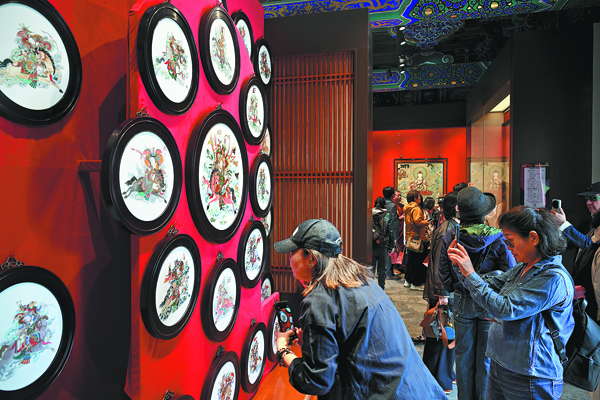
Among the most striking works on display are porcelain panels inspired by the epic of King Gesar — a centuries-old oral tradition often described as one of the world's longest epic narratives, recounting the heroic deeds of a legendary Tibetan ruler and his warriors.
The porcelain series depicts more than 30 generals in elaborate armor, each rendered with distinct expressions and movements. Created by thangka artists from Rangtang, who work in China's porcelain capital, Jingdezhen in Jiangxi province, the pieces are the result of years of experimentation.
Translating thangka imagery onto porcelain involves bridging two very different artistic systems, as traditional thangka painting is typically created on cloth using mineral pigments, while porcelain requires high-temperature firing, the exhibition organizers note.
Artists have to adapt Tibetan painting techniques to ceramic surfaces. The finished works retain the detailed linework and storytelling associated with thangka while taking on the glazed depth and luminosity of porcelain.

Crossing distances
The journey from Rangtang to Beijing is not an easy one. Located deep in the Aba Tibetan-Qiang autonomous prefecture, the county is more than 500 kilometers from the provincial capital, Chengdu, often requiring over 10 hours of travel by road.
Yet, that remoteness has also helped preserve Rangtang's remarkable concentration of intangible cultural heritage. The county is home to 143 registered heritage items and dozens of training workshops, where artisans spend years mastering crafts passed down through generations.
For three consecutive years, those traditions have traveled beyond the plateau. Artisans, performers and cultural practitioners have made their way to Beihai Park, turning what began as a one-time exhibition into a recurring cultural exchange.
Inside the temple halls, visitors move between rows of thangka paintings, glazed porcelain panels and carved wooden blocks, while conversations about the history and techniques behind the exhibits fill the space.
In one corner, artisans demonstrate how horse motifs are printed onto Tibetan paper using hand-carved plates. At another, visitors trace gold lines onto black ceramic pieces under the guidance of instructors. Nearby, shelves of crafts and food products, from hand-shaped pottery cups to woven textiles and highland snacks, invite visitors to browse, touch and purchase.
"There are exhibitions, but also experiences," says Ren Kai, deputy director of Beihai Park.
"Visitors can see, participate and even take something home."
This shift, he adds, reflects a broader change in how the exhibition is designed, moving away from passive viewing toward hands-on participation, where cultural objects become part of a lived experience rather than distant artifacts.
Cao Fei, who is in charge of the interactive programs, guides visitors to press their fingers carefully on a sheet of fibrous Tibetan paper at a long wooden table. Beside them, a local artist lifts a carved wooden block from a tray of ink, then steadies each visitor's hand as the paper meets the surface.
When the paper is peeled away, a vivid horse image emerges.
"It is a wind horse, a traditional motif symbolizing luck and the carrying of prayers," Cao says.
"This year we introduced more hands-on activities. We want people not only to see these traditions, but also to understand how they are made."
The paper itself carries a story. Made from the roots of the wolfs-bane plant, it is produced through a labor-intensive process of lifting pulp from water by hand, sheet by sheet.
"It is highly durable and resistant to water, insects and decay, which is why it has long been used for printing important scriptures," she says.
Around the corner, another group gathers around a table of dark matte pottery. Visitors dip fine brushes into gold pigment and carefully trace characters across curved surfaces.
Cao sees the distance between the plateau and the capital dissolving through these interactions.
For Wang Zhen, general manager of the Beijing Tourism Group's subsidiary BTG Tourism Development, this shift reflects something larger than exhibition design.
"It's about helping people understand the deeper value of these crafts. They are not simply artifacts, but living art forms that still resonate in contemporary life," Wang says.
He sees the exhibition as part of a broader effort to transform cultural heritage into an emotional and intellectual journey shared by both creators and audiences.
"When visitors understand the stories, techniques and meanings behind these artifacts, they stop seeing them as distant objects from another time and place and begin to see them as part of their own cultural fabric," Wang says.
Over the past three years, BTG Tourism Development has worked with Rangtang to build a pathway linking exhibitions with tourism routes, study programs and product development.
The county's remoteness, once viewed as a disadvantage, has increasingly become part of its appeal, Wang says. Many visitors, he notes, are urban professionals seeking a slower, quieter experience.
"When they arrive, they don't feel the journey was long, and most believe it was worth it," he says.
Outside the exhibition halls, that value becomes tangible.
Growing interest
At a small stall, Badanlam arranges rows of handmade pottery while speaking with visitors who stop to test the texture and weight of her work.
"People have been showing strong interest in our handcrafted items," says the woman in her 20s.
Her coffee cups, adapted for modern use, are among the most popular items. Familiar in function, they still carry the marks of handwork, featuring slight ridges along the rim, faint thumb impressions in the clay, and small variations in thickness that reveal the rhythm of the potter's hands.
Last year, Badanlam stayed in Beijing for a week and sold hundreds of pieces. This year, she notices that the interest has continued.
But for her, the change runs deeper than sales. Growing up in Rangtang, her life was once defined by physical labor — long days spent digging for caterpillar fungus and medicinal herbs in the mountains. "Back then, we depended on labor," she says.
As a teenager, Badanlam joined a local training center and spent years learning language skills and traditional crafts. The process was slow, repetitive, and at times uncertain. Now, she makes pottery, creates traditional clay works, and explains their meanings to visitors at places she never imagined visiting. Her income has increased by about 30 to 40 percent.
"But more importantly, I can come here. I can travel. I can let people understand where we are from," she says.
Luo Xianquan, an official of Rangtang, notes that the county has been selected as one of the first national pilot counties for cultural industries empowering rural vitalization. With 46 intangible cultural heritage training workshops, the county has helped over 3,000 local farmers and herders find employment close to home, increasing annual incomes by an average of 4,000 yuan ($588) per person.
Young Tibetan women like Badanlam reflect "how 'fingertip skills' are being turned into real economic returns across Rangtang", Luo points out.
Around Badanlam, visitors continue to browse. Some leave carrying small objects ranging from a printed sheet to a lamp and a cup still bearing the imprint of a hand.
Modest as they are, they carry with them a journey that begins in the highlands, passes through fire, paper and clay, and settles quietly into everyday life.
"I'm happy that I can let people understand where we are from this way," she says.

A diverse array of artifacts, including thangka paintings, glazed porcelain panels and carved wooden blocks created by artisans from Rangtang county, Sichuan province, is on display at Beihai Park in Beijing. [Photo provided to China Daily]
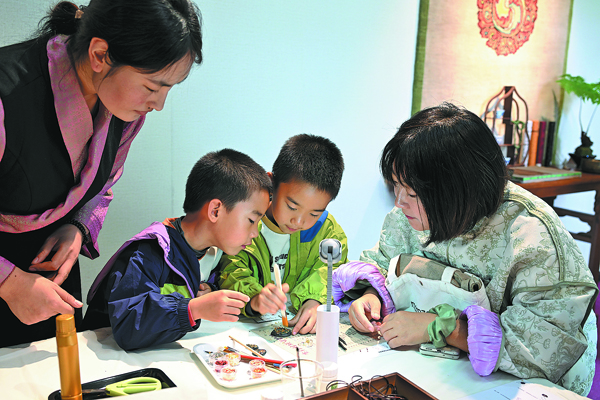
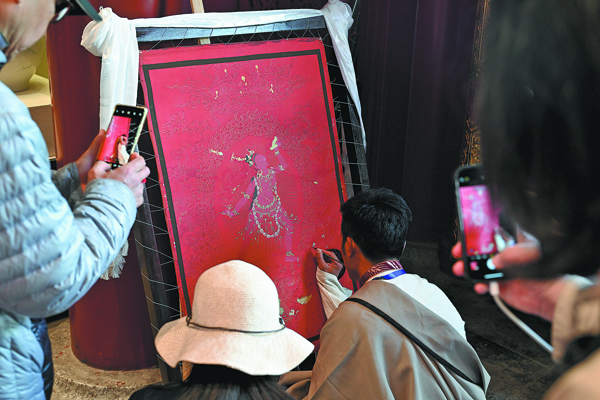
The event at Beihai Park features (from top) a live demonstration of thangka painting, hands-on workshops and traditional Tibetan music and dance performances. [Photo provided to China Daily]
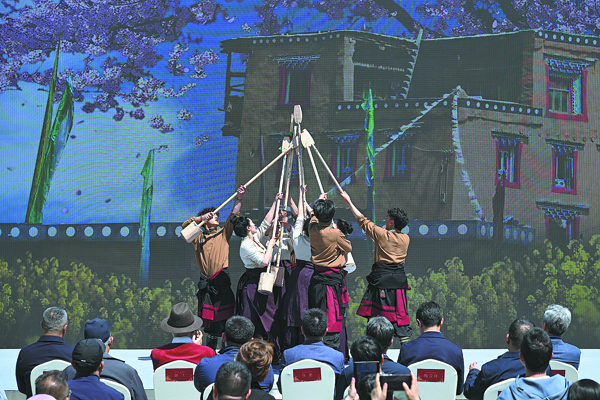
The event at Beihai Park features (from top) a live demonstration of thangka painting, hands-on workshops and traditional Tibetan music and dance performances. [Photo provided to China Daily]
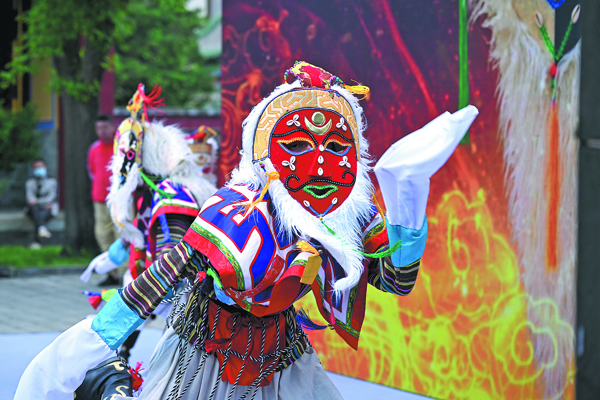
The event at Beihai Park features (from top) a live demonstration of thangka painting, hands-on workshops and traditional Tibetan music and dance performances. [Photo provided to China Daily]
责编:田梦瑶
一审:田梦瑶
二审:黄思婷
三审:秦慧英
来源:中国日报网
我要问
 湘公网安备 43010502000374号