


 下载APP
下载APP 报料
报料 关于
关于
中国日报网 2026-05-17 15:06:03
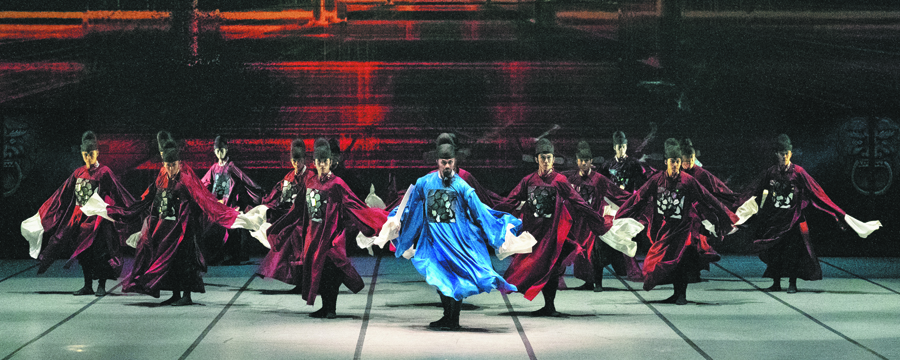
In the rolling hills of Guizhou province, a young scholar once found himself exiled, on the brink of despair. From that crucible emerged one of China's most influential thinkers: Wang Yangming (1472-1529), whose philosophy and actions would go on to inspire generations.
His life and ideas leap from history texts into motion in Wang Yangming, an original dance drama directed and choreographed by Wang Yabin and performed by dancers of the Guizhou Song and Dance Theatre. The production debuts at the National Centre for the Performing Arts in Beijing on Saturday and Sunday as part of its eight-month nationwide tour.
"I wanted to bring Wang Yangming to life on stage," Wang Yabin says, "to show his trials, his enlightenment, and the way he guided others. I hope audiences feel the rhythm of his life and the spirit of his philosophy."
The drama retraces a pivotal chapter in the life of the Ming Dynasty (1368-1644) philosopher. Wang Yangming, born in today's Ningbo, Zhejiang province, then a minor official in the government, was demoted to a remote post in Longchang, Guizhou province, after criticizing the powerful eunuch Liu Jin.
Being sent to Longchang, known as a "political, cultural and economic wasteland", actually gave Wang Yangming a unique opportunity. His idea that knowledge and action should be unified wasn't just abstract. In Longchang, he had to solve real problems, from local rebellions to corrupt officials. This allowed him to put his moral principles in action, showing that his theories weren't just talk — they worked in the real world.
The remoteness also meant less interference from conservative court officials, allowing him to try new administrative and military strategies. He could experiment with governance, discipline and moral education among local troops and officials.
"I spent two weeks reflecting," Wang Yabin recalls. "I studied Wang Yangming's writings, spoke with friends who admire him, and considered how to translate his philosophy into movement. His life is epic; one of the brightest periods in his life happened in Longchang, and it became the focus of the choreography."
Her research led her to Guizhou province, where she immersed herself in the region's landscapes and culture.
"The beauty and simplicity of Longchang relaxed me and opened my imagination," she says. "I tried to imagine Wang Yangming's state of mind at the moment of enlightenment. I developed a creative approach: understand the essence first, then translate that understanding into dance and stage aesthetics."
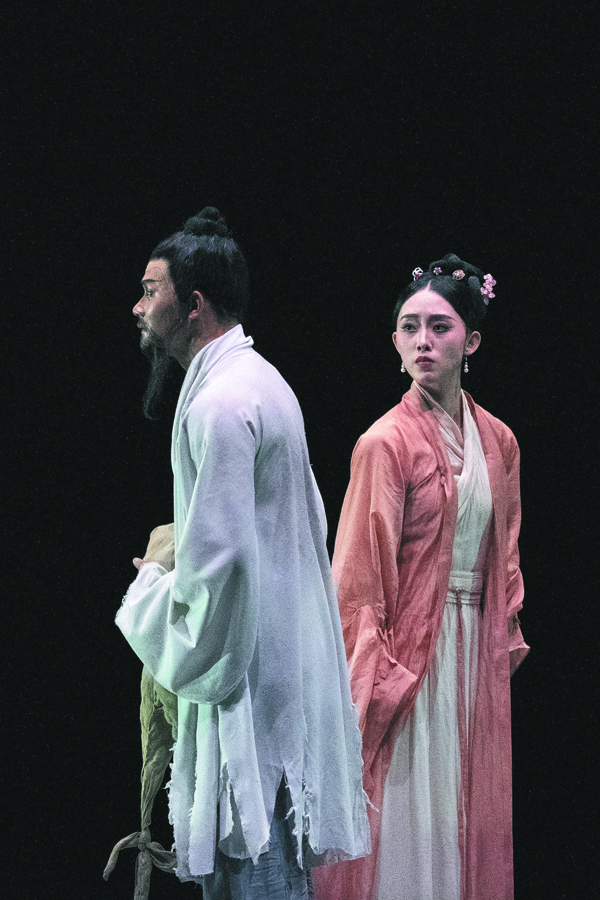
The dance drama unfolds in five acts: Prologue, Seeking the Way, Enlightenment, Verification, and Epilogue — and features a dual narrative of a young and an adult Wang Yangming.
The young Wang Yangming, brimming with ambition, mirrors the inner drive that propels the philosopher toward insight. Wang Yabin draws on Guizhou's ethnic culture and modern dance techniques, merging them to create a dialogue between the philosopher's internal journey and the region's landscapes and traditions.
For example, Nuo Opera elements add texture, while sequences depicting Wang Yangming's pursuit by the imperial secret police dramatize the obstacles he faced, enhancing both the narrative's tension and pacing. Minimalist stage design evokes Ming Dynasty aesthetics, providing a historical anchor to the modern choreography.
The dance drama premiered in Guizhou in November 2024. Then, after months of touring, Wang Yabin and her team refined the performance.
"Following each show, we adjust the actors' expressions, timing and transitions," she says. "The integration of lighting, sound and stage technology becomes more seamless with every performance."
Wang Yabin is no stranger to ambitious projects. Over 10 years ago, her dance drama The Moon Opera, adapted from award-winning writer Bi Feiyu's novel of the same title, toured more than 150 performances at home and abroad — a milestone in her career and also in the country's contemporary dance scene.
Now, she returns to a familiar platform, using the universal language of movement to interpret a distinctly Chinese story.
The dance drama's music mirrors the dualities of the philosopher's life, moving between the grandeur of his public trials and his quiet, reflective thoughts.
"We based the score on his heart-mind thinking," composer Lyu Liang says. "It moves between grand, patriotic grandeur and quiet, introspective calm — moments of high ambition and moments of serene reflection. The music is meant to express the turbulence of his life alongside the steadfastness of his thoughts."
A symphony orchestra forms the backbone of the score "to convey the epic scope of the story and the rises and falls of Wang Yangming's personal journey", the composer adds.
Traditional Chinese instruments, including the bamboo flute, the guqin (a seven-stringed Chinese zither), guzheng (Chinese zither), and erhu (a two-stringed fiddle), imbue the music with "an elegance and meditative, Confucian serenity", he says.
Guizhou's ethnic instruments, meanwhile, reflect the landscape and culture of Wang Yangming's exile, their raw, earthy tones evoking the isolation and ruggedness of Longchang. "The result," the composer says, "is a layered, emotionally rich musical landscape that balances sweeping ambition with intimate reflection, and brings both the man and his philosophy vividly to life".
责编:田梦瑶
一审:田梦瑶
二审:黄思婷
三审:秦慧英
来源:中国日报网
我要问
 湘公网安备 43010502000374号