


 下载APP
下载APP 报料
报料 关于
关于
中国日报网 2026-04-07 10:20:18
A riverside realm shaped by literature and memory, Yang Feiyue reports.
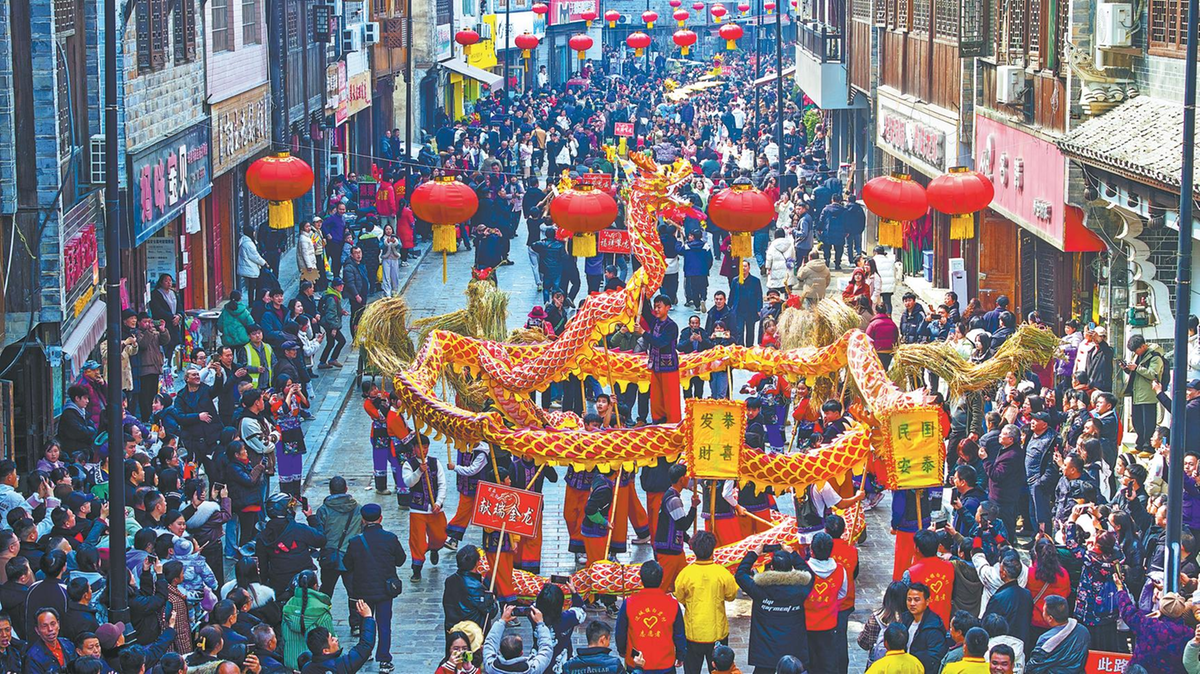
A traditional dragon dance showcases the enduring charm of folk art in Biancheng, Hunan province. CHINA DAILY
Standing at the junction where three provinces meet, with Hunan beneath my feet, Chongqing to my left, and Guizhou to my right, I recall renowned writer Shen Congwen's iconic line from Border Town: "Perhaps he will never return, perhaps he will come back tomorrow."
More than nine decades later, the novel's protagonist Cuicui's beloved didn't return, but generations of readers have followed Shen's words to this place called Chadong ancient town in the Xiangxi Tujia and Miao autonomous prefecture, Hunan province.
As the real town that inspired the story, Chadong was renamed Biancheng (Border Town) in 2005 in its honor.
In 1988, Shen died in Beijing. Few know that this literary master was born in Fenghuang town, about a two-hour drive from Chadong, and he joined the military at 14, traversing Hunan, Sichuan and Guizhou provinces.
During a few days' stay in Chadong, the landscape etched itself into his soul and later emerged in his prose.
Following our guide Tian Xia, we enter the ancient town along the "official road from Sichuan to Hunan" that opens Shen's novel.
Our first stop is Cuicui's residence beneath the white pagoda. Cured meats hang above the fire pit, wine bowls rest on the table and fishing nets adorn the walls.
"This is her grandpa's room — close to the fire, where elders sleep in Xiangxi," Tian explains, while pointing to a smaller one facing the Qingshui River running below.

A bird's-eye view of the ancient town, where Hunan meets Chongqing and Guizhou. CHINA DAILY
"And that's Cuicui's room."
Tian is a local woman who studied foreign literature in northern Hebei province. When her tutor saw Border Town on her file and asked if it was Shen Congwen's Border Town, Tian saw the significance of her hometown and decided to return a year and a half ago.
"I felt a sense of mission to promote my hometown to a wider audience."
In Shen's novel, Cuicui's quiet life by the river was disrupted when two brothers — Tianbao and Nuosong — both fell in love with her. Tianbao, the elder, spoke first; Nuosong, the younger, sang from across the water.
In a place where love is won through mountain songs, Cuicui's heart answered Nuosong without words. Tianbao, defeated and heartbroken, left by boat and drowned. Guilt drove Nuosong away too, leaving Cuicui alone by the river, waiting and pining.
Today, the white pagoda above Cuicui's home still stands on the hill, watching silently as modern visitors bring the story back to life. Down the slope, a viewing platform offers the perfect photo spot that frames the pagoda and residence together, where fiction and reality finally align.
As one goes further into the town, a unique ferry operates on the Qingshui River — a steel cable spans the river, and boatmen pull wooden poles with grooves along it.
"They were originally hemp ropes, replaced with steel cables in the 1990s," Tian explains, adding that this pulling ferry has existed since old Chadong, exactly as described in the novel.
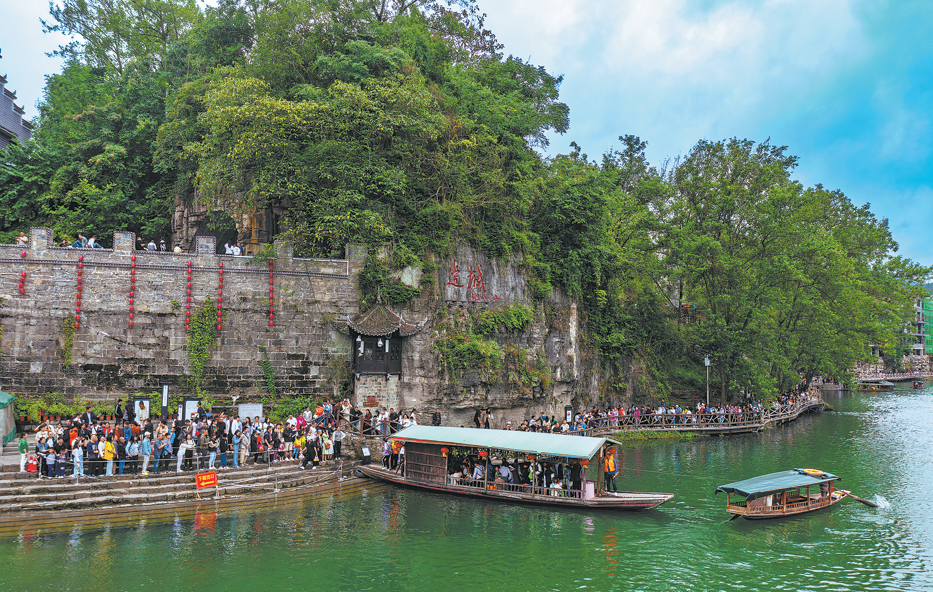
A scenic boat ride from Biancheng to Chongqing's Hong'an town is among the most popular choices for travelers. CHINA DAILY
The boatman initially exerts effort, then glides by inertia. Across the river lies Hong'an ancient town of Chongqing.
In minutes, I've crossed from Hunan to Chongqing. Here, crossing provinces takes less time than brewing tea.
Standing at the three-sided boundary marker — a triangular tablet facing Hunan, Chongqing, and Guizhou — as we boat back to Biancheng, Tian notes that the place they call "one foot in three provinces" has become an internet hot spot where visitors pose with arms and legs stretched, collecting location tags like souvenirs for their social media posts.
Looking around this vantage point, cooking smoke slowly rises into the air across the riverbanks, while village women kneel by the water's edge, washing clothes as their wooden paddles beat out rhythmic thuds mixed with laughter and chatter.
"The town has no heavy commercial atmosphere, and strives to create a quiet and pure atmosphere for visitors to unwind," Tian explains.
In 2021, construction began on the Chadong cultural tourism zone in Biancheng.
By August 2022, the upgraded ancient zone revealed itself anew, with a restored Red Army command post, historical teahouse and Shen Congwen's former residence.
The goal has been to create a quiet, simple town where visitors can enjoy an idyllic, pastoral life, according to the Biancheng authorities.
Tian points to cliffside caves as we walk back along the riverbank.
"They are hanging coffins, which were originally from a Guizhou funeral custom. Here, where cultures blend, you see traditions from all three provinces," she explains.
This blend has been most evident in cuisine. The signature dish is "One Bite Tastes Three Provinces" featuring a fish hotpot using Hunan's spiciness, Guizhou's sourness and Chongqing's numbing pepper. One mouthful delivers three provinces' flavors in delicious combat.
During the Dragon Boat Festival, teams from the three provinces gather on the Qingshui River for races, Tian says, inviting me to come back for the holiday.
"Afterward comes duck-catching — hundreds of ducks tossed in the river, anyone can keep what they catch. In the novel, Cuicui and Nuosong first met at such a festival," she elaborates.
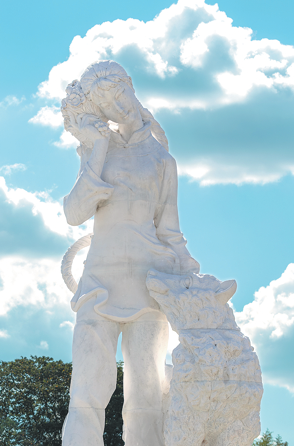
A sculpture of Cuicui, the heroine of Shen Congwen's novel Border Town. CHINA DAILY
Today, over 80 percent of the nearly 25,000 residents are indigenous, lending authentic vibes to local life. By the river, people dry cured meat, and at bridges, they sell rice cakes. Alleyways are dotted with Miao embroidery shops.
During peak seasons, Tian says, over 30,000 visitors come here daily.
"Most of them come from Guangdong province and Guangxi Zhuang autonomous region."
They mostly take home ethnic Miao embroidery, silver hats, necklaces and bracelets, as well as creative cultural items full of ethnic elements, she notes.
Tian has also received Southeast Asian tourists who know about the place from Shen's novel.
"They know something about Border Town, and are eager to find places in the novel's description," Tian says.
As we are about to bid farewell to the place, we come across a yellow dog dozing at the dock, seemingly indifferent to passing tourists.
Tian half-jokingly says that perhaps it has seen too many come and go.
"Unlike Cuicui, who had waited for just one."
Perhaps that is Border Town's deepest magic, which lies in the fact that literature has never left.
It lives in every local girl — visitors can greet them as "Cuicui", and they'll smile, recognizing the name as a kind of homecoming.
Shops here and there are also bearing the names of items from Shen's novel, tugging at visitors' hearts, leaving us to wonder: where does the story end, and where does reality begin?
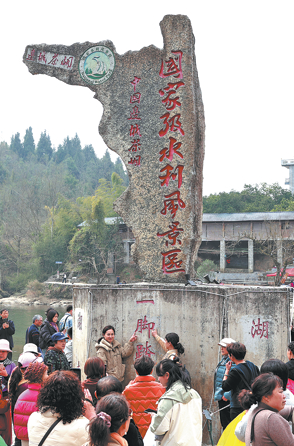
A boundary marker where one step spans three regions, located along the Qingshui River at the junction of Biancheng, Hong'an in Chongqing, and Yajia in Guizhou province. CHINA DAILY
If you go
By rail: Take a high-speed train to Jishou East Station. From there, take a 60-minute local bus or taxi ride to Biancheng (Chadong ancient town).
By air: The nearest airport is Xiangxi Biancheng Airport. From there, take a 40-minute taxi ride to Biancheng.
Getting around: The ancient town's core area is compact and best explored on foot along its cobblestone lanes. To cross between provinces, try the iconic "pulling ferry" from Hunan to Chongqing.
责编:黄思婷
一审:黄思婷
二审:王柯沣
三审:秦慧英
来源:中国日报网
我要问
 湘公网安备 43010502000374号