


 下载APP
下载APP 报料
报料 关于
关于
中国日报双语新闻 2026-03-18 16:33:32
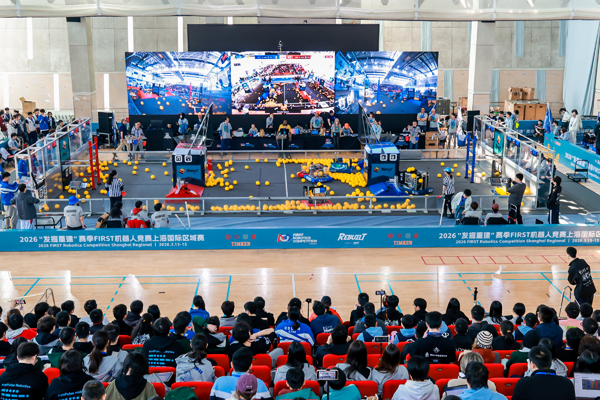
In a bustling arena at East China Normal University, the whir of motors and cheers from competitors and spectators filled the air during the 2026 FIRST Robotics Competition (FRC) Shanghai Regional, held from March 13 to 15. Nearly 1,000 young innovators representing 50 teams from around the world gathered to showcase their engineering prowess.
This year's challenge, themed "Rebuilt", encourages participants to explore history through an engineering lens. Teams compete in qualifying rounds before advancing to elimination matches, with the top performers earning a spot at the global finals in Houston, United States, this April.
During each match, alliances must complete a series of tasks within limited time, such as scoring fuel, crossing obstacles, and climbing towers. Each match begins with a 20-second autonomous period, during which robots operate on their own, followed by 2 minutes and 20 seconds of driver-controlled gameplay.
"That's a very real-world engineering and machine learning application that students are being exposed to," said Collin Fultz, senior director for FRC."The annual game changes ensure that each group of students experiences a fresh challenge in strategy development, robot design, building, and programming. They can't simply reuse last year's design."
Fultz also highlighted the global scale of the competition. "What makes this unique is that teams all over the world are playing the exact same game," he said. "This weekend alone, there are more than 30 events taking place across six different countries."
The competition is also expanding rapidly in China. Chen Bangchao, business director of the FRC China committee, noted that the number of Chinese teams participating has increased by 20 percent compared with last year.
"We believe this is more than just a robotics competition," Chen said. "It's also a platform for addressing important social issues, encouraging students to care about society and develop solutions to real-world problems.""I find robotics fascinating — how a collection of parts can be transformed through manufacturing into something that moves," said Wang Po-hao, a competitor from Our Lady of Providence High School in Taiwan. "I love turning my ideas into engineering drawings and then into actual products."
Wang was primarily responsible for engineering on his team. "We started with engineering drawings and used wooden boards to test early prototypes," he explained. "After confirming that the design was feasible, we upgraded the components and continued making adjustments and improvements."
Through the process, Wang gained meaningful insights into design. "I've learned that effective design must not only achieve its intended purpose, but also consider reliability, stability, component integration, and efficiency," he said. "I may choose this field for my future studies or career, and I believe the knowledge I've gained here will be extremely valuable."
Lu Yixuan, captain of the Violet Z 6940 team from the Minhang Zizhu Branch of the No 2 High School affiliated with ECNU, shared a similar perspective, highlighting the strong sense of ownership students feel toward their work. Her team secured an alliance victory as the first runner-up at last year's FRC event and later advanced to the world championship in Houston.
"Every match affects me emotionally because our robot is entirely designed and built by students — from the initial blueprints and 3D modeling to custom assembly," Lu said proudly. "Working on the robot has given me a deep sense of belonging and pride in what we've accomplished. Once I truly understood this field, I fell in love with robotics."
责编:田梦瑶
一审:田梦瑶
二审:秦慧英
三审:张权
来源:中国日报双语新闻
我要问
 湘公网安备 43010502000374号