


 下载APP
下载APP 报料
报料 关于
关于
长沙市政府门户网站 2026-01-12 15:01:58
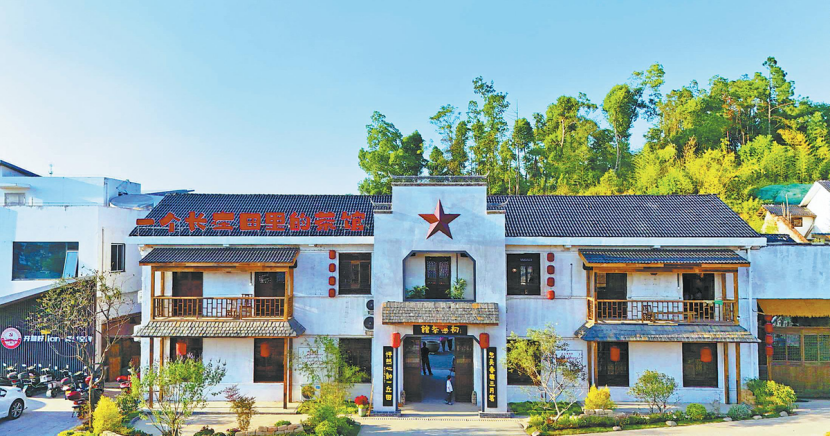
The facade of the First Love Teahouse in Kaihui township, Changsha, Hunan province, is reminiscent of a bygone era. [Photo provided to China Daily]
The rhythmic beat of drums and the fragrant steam of poured tea rise above the rice paddies in Kaihui township, embraced by the heady sound of laughter and people having a good time. This is the atmosphere at the First Love Teahouse, what was supposed to be a quiet slice of nostalgia on the outskirts of Changsha, capital of Hunan province, but what has become a sensation for its queuing clientele.
At lunchtime on an ordinary weekday, the halls and private rooms of the teahouse bustle with guests, many of whom have driven for over an hour from downtown Changsha.
What has hooked so many guests is the traditional and nostalgic atmosphere of the teahouse. Its decor all stems from a bygone era, a time when farming and family were the core of daily life. The tea, local specialties and lively performances have kept guests coming back for more despite the teahouse only opening in September. Huagu Opera, or flower-drum opera, is a particular favorite when it hits the hall's main stage.
"The dishes, the performance, the culture ... everything feels like from our childhood," said one of the guests who grew up in the region.
The teahouse is a repurposed building from a rural supply and marketing cooperative, and so it perfectly encapsulates that rural feel. Dubbed "a teahouse grown on the farmland", its design is deeply rooted in the agrarian culture back in the 1980s. More than 600 vintage objects donated by local villagers are on display inside and out, such as aluminium water kettles, enamel tea mugs and bamboo baskets, turning the space into what its founder calls a "rural cultural living room".
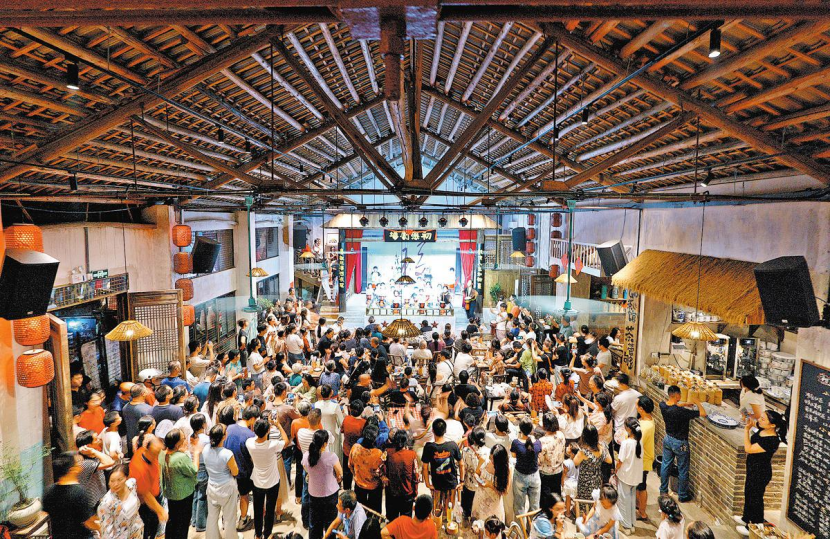
Customers pack the First Love Teahouse to watch a Huagu Opera show. [Photo provided to CHINA DAILY]
"We are not just selling tea, we are offering our guests a rural lifestyle," said Yi Dan, the founder of the teahouse. "The 'first love' in the name aims to evoke nostalgia for one's initial, fond memories of the countryside," he said.
Just a few weeks after its opening, the teahouse experienced its first major peak in customer flow during the National Day holiday in October, far exceeding Yi's expectations. It saw an average of more than 800 tables queuing daily, a figure that represents thousands of customers waiting for a seat.
"Initially, we planned to invite our friends and relatives to be the first guests, hoping they would help spread the word about the teahouse," said Wang Wanlei, deputy head of Kaihui township.
"However, the teahouse quickly gained popularity on social media platforms, and we had to implement provisional measures to manage the unexpectedly large influx of cars and guests during the holiday."
The teahouse's appeal cuts across generations, Wang said. Seniors can find childhood memories, youngsters can seek novelty and photo opportunities in themed rooms, and children can play in the sandpits and swings in the yard, or enjoy themselves in the surrounding farmland and ponds.
The immersive cultural experience offered by the teahouse has also attracted international guests. In late November, the teahouse welcomed nearly a hundred students from more than 30 countries studying at Hunan Agricultural University. They enjoyed tea and snacks, experienced baduanjin (a traditional Chinese fitness exercise), watched Huagu Opera performances, and learned to play local hand drums while singing Hunan folk songs.
This model of a nostalgic, shareable experience has fueled the teahouse's popularity, and taps into a cultural and economic shift.
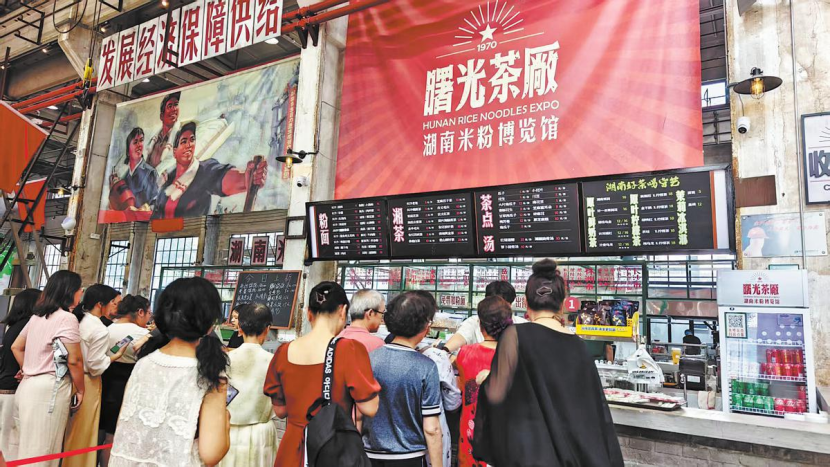
Customers line up to order at Shuguang Tea Factory. [Photo provided to CHINA DAILY]
Yi, the founder, has noticed a shift toward more mindful spending in this age of uncertainty. "Consumers are becoming more rational, opting for peaceful experiences over extravagant meals and nightclubs," he said. In this context, the teahouse aims to offer exhausted urbanites a space for a "psychological massage", where they can truly relax and reconnect with nature, he added.
In Changsha, a city renowned for its vibrant consumption landscape, the revival of tea culture is evident through a diverse array of teahouses, each offering unique experiences to cater to contemporary urbanites.
Shuguang Tea Factory in Yuhua district presents a grand and integrated vision. Housed in a renovated 4,000-square-meter building that once served as an industrial plant, the complex transforms its manufacturing heritage into a sanctuary for modern leisure. Beyond its tea offerings, which range from traditional brews to modern infusions, the venue also features the Hunan Rice Noodle Expo — an exhibition and dining space showcasing signature noodle dishes from 16 cities across the province. Since its opening in October, the space has quickly become a popular urban hot spot.
Not far away, in the bustling Furong district, Dongmao Street Teahouse has been designed as an "urban cultural living room" for both locals and tourists. Here, a single cup of tea is priced at 8 yuan ($1.14), and a piece of congyou baba, a savory, donut-shaped classic local snack, is just 2 yuan.
With its modest pricing, the teahouse has become a daily retreat for elderly residents from nearby areas, while tourists often visit to capture its unique ambiance.
"At its peak, we sell over 3,000 cups of tea a day," said Li Jiang, a founding partner of the teahouse.
A waitress serves a customer at Shuguang Tea Factory in Yuhua district, Changsha. [Photo provided to CHINA DAILY]
Source: China Daily
责编:王柯沣
一审:王柯沣
二审:秦慧英
三审:张权
来源:长沙市政府门户网站
我要问
 湘公网安备 43010502000374号