


 下载APP
下载APP 报料
报料 关于
关于
中国日报网 2025-12-29 17:05:31
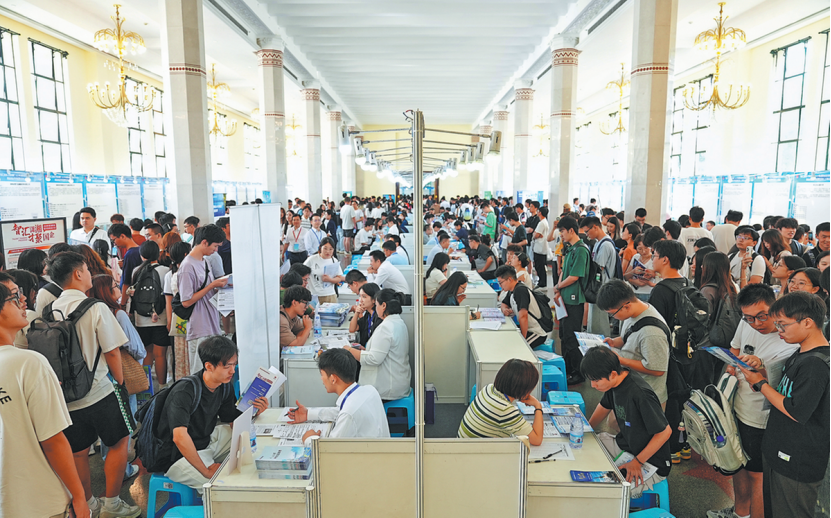
College graduates participate in a job fair held by Hunan province in Shanghai earlier this year, which is part of the province's program to attract young talent. FU CONG/FOR CHINA DAILY
In the eyes of entrepreneur Zhang Jiayu, starting a business in Changsha, capital of Hunan province, is as natural as fishing by the river or taking a walk in the park — a completely normal and fitting endeavor.
He said stories of young entrepreneurs sometimes raise doubts and distrust, but in this city, it's generally considered a consensus that young people should pursue entrepreneurship.
"The atmosphere is strong. You can see promotional slogans for startups on the streets, reception desks for entrepreneurship services at airports and railway stations, and attend various entrepreneurship events," he said, adding that the city's efforts to support entrepreneurs are unrivalled.
Zhang, 23, a post-graduate from the Renmin University of China in Beijing, set up his company Aqing (Liuyang) Culture and Technology Co at the Smart Liuyang cultural creativity incubation base in Changsha in early December, producing and selling electric firecrackers.
Compared to traditional gunpowder firecrackers, the company's wall-mounted confetti firecracker bursting machines are considered safer and greener as they realize the bursting effect via aluminum foil balloons and motor-driven explosions. They can also be used indoors, such as during weddings and when customers buy new cars at 4S stores, according to Zhang.
As part of the local preferential policies to support entrepreneurship, Zhang doesn't need to pay rent for his operations in the first three years, and enjoys government subsidies from both the provincial and city levels. He said local officials enthusiastically welcomed him and took him to visit major local firecracker producers.
He said Changsha's economy has developed fast and has attracted many manufacturing companies, creating a complete industrial chain, crucial for a startup to expand its market. "First-tier cities have many opportunities, but they may not be suitable for everyone. What's more important is to find regions where our advantages can be fully exploited," he said.
Zhang's entrepreneurship project is one of the 80 newly settled in the province after a nearly two-month promotional event organized by the provincial human resources and social security department. The event recruited college graduates and attracted entrepreneurship projects from eight cities such as Beijing and Shanghai from Sept 21 to Nov 9.
Liu Gengye, a doctoral graduate from Tsinghua University, attended the promotional event and ended up at an innovation and entrepreneurship base in Changsha's National Wangcheng Economic and Technological Development Zone. His project focuses on satellite communication terminals and on-board payloads.
He said the base provides 360 square meters of R&D and office space with a three-year rent-free period. It also offers a 200,000-yuan ($28,400) startup subsidy and an annual 100,000-yuan technical service subsidy. "It effectively alleviates the financial pressure in the initial startup stage," he said.

Young entrepreneurs work at Changsha Zhigu College Students'Entrepreneurship Base in Hunan. [Photo provided to CHINA DAILY]
The base also provides 11 free entrepreneurship support services, including industrial and commercial registration, investment and financing matchmaking, and one-on-one mentoring and guidance from startup advisors.
"In terms of daily life, apartments are located just 500 meters away from the base. As a doctoral graduate, I can rent an apartment at a 50 percent discount for only about 400 yuan per month," he added.
Within a 1-kilometer radius of the office building, there are well-equipped pilot-scale and industrialization workshops, which provide "seamless convenience for our subsequent product trial production and large-scale manufacturing", according to Liu.
The base also has cafeterias and shuttle buses for entrepreneurs. Jiang Ruodan, director of the investment promotion and innovation and entrepreneurship service center in the zone, said it welcomes early-stage, small projects. There are more than 60 college students' projects, including 10 receiving a total of 6.8 million yuan in funds from the province, he said.
Li Peiheng, 23, founder of startup Changsha Moshushi Intelligent Technology Co, registered the company at the Changsha Zhigu College Students' Entrepreneurship Base earlier this month, focusing on wireless charging systems for drones and robots. He said the base provided robust support for industries engaged in the low-altitude economy and robotics, and has approved dedicated test sites for them.
In addition, the company has received sufficient funding from the government for R&D efforts, as well as a patent preexamination channel, enabling Li to obtain patent authorization within just a few months. It also assists in recruiting interns and fresh graduates, he added.
A native of Shenyang in Northeast China's Liaoning province, Li graduated from the Harbin Institute of Technology last year.
He said the reason he chose to settle there is that Changsha is a dynamic and livable city.
"It has a strong appeal to young people, boasts abundant medical resources, and features relatively affordable housing prices as well as diverse entertainment options. Furthermore, Changsha offers robust support for college students' entrepreneurship," he said.
From October last year to October this year, Changsha saw an addition of 8,730 business entities founded by college students, according to local authorities.
Entrepreneurship projects launched by those with a master's degree or above account for 61.74 percent. Technology-driven innovation projects make up 74.78 percent, while projects related to emerging and future industries account for 70.43 percent, data from local authorities showed.
Hunan established the country's first dedicated investment fund for college students valued at 505 million yuan in October last year.
A series of supportive policies have also been introduced, covering college students' training, guaranteed loans for startups, and entrepreneurship subsidies, according to Li Yongjun, director of the provincial human resources and social security department.
"Now is the perfect time to start a business in Hunan, as we have the right timing, favorable conditions and vibrant atmosphere," Li said.
As of the end of November, the province had 427 entrepreneurship incubation bases housing 16,255 projects. Among them, there were 3,982 college student entrepreneurship projects, representing a 91.4 percent increase compared with May, data from local authorities showed.
The Standing Committee of the Communist Party of China Hunan Provincial Committee discussed the Implementation Opinions on Building a Youth-Friendly Province on Dec 15, with a core goal to attract more young talents to grow and thrive in Hunan. It's regarded as a key part of the province's social and economic development during the 15th Five-Year Plan (2026-30).
Among the opinions were those on implementing measures such as boosting employment by developing manufacturing and service industries, supporting high-caliber talent in technology, improving public services, and organizing consumption activities for young people.
责编:黄思婷
一审:黄思婷
二审:王柯沣
三审:秦慧英
来源:中国日报网
我要问
 湘公网安备 43010502000374号