


 下载APP
下载APP 报料
报料 关于
关于
中国日报网 2026-02-02 09:24:12
Guo Dongcai is a professor from the College of Chemistry and Chemical Engineering of Hunan University. Rather than working only in laboratories, he dedicates some time to visiting petrochemical companies around the province as a senior technical expert and technology manager at the Yuelushan Center for Industrial Innovation.
Founded in Changsha, the center consists of four laboratories — intelligent manufacturing, industrial design, inspection and testing, and food engineering and safety — as well as eight research departments. Its key task is to advance development and research in Hunan's industry sector and support enterprises' technological innovation.
"We technology managers serve as a bridge between researchers and enterprises. We learn about enterprises' technical problems and help match them with a research team to solve these problems," Guo said.
During his visit to Changde New Materials Technology in Hunan's Yueyang city in 2024, Guo learned that the enterprise was eager to optimize its production processes for alcohol ether products. As a result, he connected it with the research team led by Professor Luo Xiao at Hunan University.
After more than six months of efforts, the collaborative project has achieved much progress: indicators for material and energy consumption have declined, and production efficiency has been improved.
The company currently is pushing the second-phase research project with Luo, which, in the best case, will cut costs by nearly 10 million yuan ($1.41 million) annually, according to its staff members.
As of now, the center has employed more than 50 technological managers, offering services for 2,593 enterprises in the province.
"Large enterprises have regular cooperation resources, so our technological managers put more emphasis on small and medium-sized enterprises. By addressing the technical limitations of SMEs, we can promote the transformation and upgrading of Hunan's industries," said Yu Jinqing, deputy director of the center.
Yu added that they are planning to expand the technological manager team to 100 people, enabling more professors to bring their expertise into factories.
In partnership with the Hunan Department of Industry and Information Technology, the center also established an online platform to foster cooperation between enterprises and expert teams. Through the platform, registered enterprises can post their technological demands and search for the people they need. Meanwhile, expert teams, including those from home and abroad, can accelerate the transformation of their research results, according to Yu.
Official data showed that the center identified 2,422 technical needs from 1,683 companies in 2024 and signed research cooperation agreements with 121 companies, involving funds of 234 million yuan.
It has also launched 40 projects for the shared technological needs of Hunan's key industrial sectors, achieving 22 research results and developing nine products.
Among them is a project on gas foil dynamic bearing technology. Based on this, the center and CRRC Zhuzhou Electric have jointly developed air suspension high-speed centrifugal blowers of different power ratings, and exported these products to Southeast Asian countries.
Local officials said Changsha has been accelerating the development of major sci-tech research platforms in recent years. Meanwhile, it has strengthened the coordination of research innovation and industrial innovation, contributing to its goal of becoming a global R&D center.
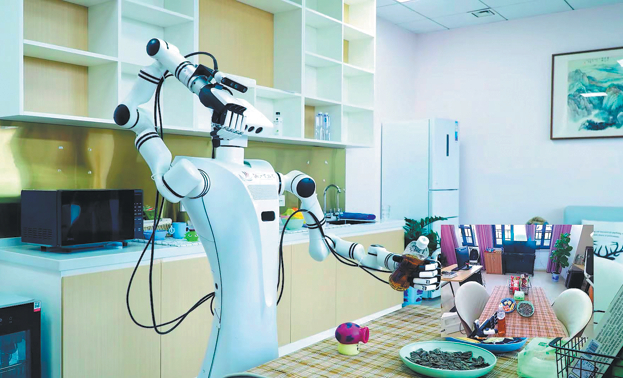
An intelligent robot developed by Xiangjiang Laboratory in Changsha.

The Yuelushan Center for Industrial Innovation in Changsha is a laboratory co-built by the Hunan provincial government and the Chinese Academy of Engineering.
The Xiangjiang Laboratory, founded in 2022, has set up more than 30 innovation research institutes in collaboration with industrial giants like Unitree Robotics. The National Supercomputing Center in Changsha, with an artificial intelligence computing power of 200 peta floating-point operations per second and equivalent AI computing power of 1,000 PFlops, is pushing forward the integrated development of supercomputing and intelligent computing.
In 2025, the city added 825 innovation platforms, taking the total number to 4,336; its 16 innovative research institutes commercialized 291 research results and incubated 64 tech startups.
责编:黄思婷
一审:黄思婷
二审:王柯沣
三审:秦慧英
来源:中国日报网
我要问
 湘公网安备 43010502000374号